
Stay inspired.
Scroll for helpful tips, stories, and news.

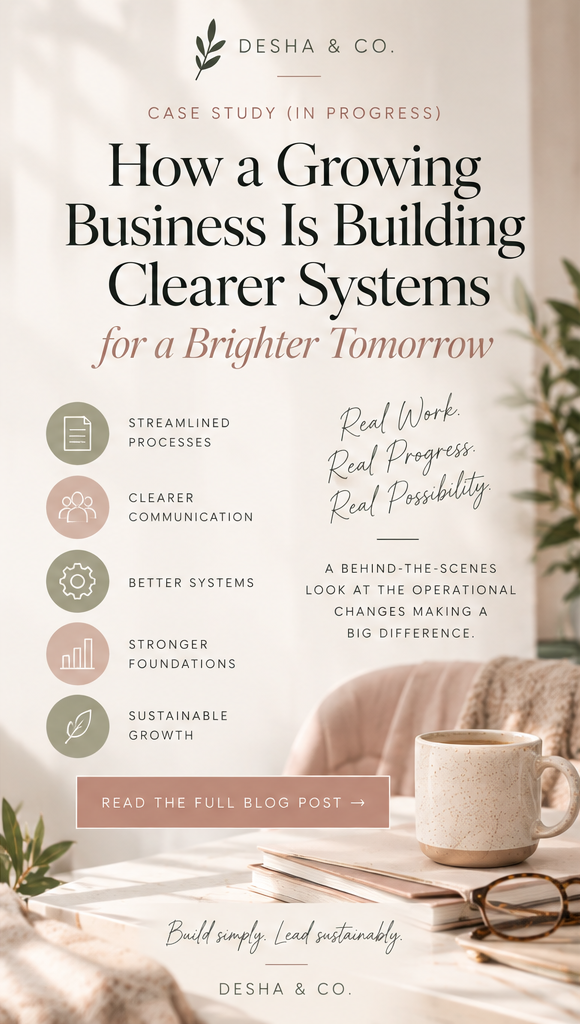
Small Business Operations Case Study: Building Clearer Systems for a Growing Service-Based Business
About this case study
This is an anonymized, in-progress example based on a current DeSha & Co. engagement. Identifying business, client, financial, and confidential information has been intentionally omitted. Because the engagement is ongoing, this case study focuses on the operational work completed to date rather than claiming final or quantified results.
Case Study in Progress: Building Clearer Systems for a Growing Service-Based Business
Growth does not always arrive with a perfectly organized operations manual tucked under its arm.
Sometimes the business grows first.
The systems catch up later.
That was the situation when I began working with a growing service-based business whose client volume, administrative needs, communication requirements, billing processes, and internal responsibilities had become increasingly interconnected.
The business itself was working.
People cared deeply about the clients they served.
Important information already existed.
Processes were happening every day.
But like many growing small businesses, much of the operational knowledge had developed organically over time.
Some information lived in individual documents.
Some lived in software.
Some lived in email.
Some lived in processes people simply knew how to perform.
And some lived in the founder’s head.
The work did not begin with:
“Let’s replace everything.”
It began with:
“Let’s understand what already exists, identify what is creating friction, and make the business easier to operate.”
That distinction is at the heart of how I approach business operations consulting.
The Challenge: Growth Had Created Layers
This business had reached the point where several operational areas needed to work together more clearly.
Those areas included:
internal policies
client-facing information
billing communication
onboarding
administrative responsibilities
scheduling communication
documentation
recurring operational processes
software and client-portal usage
None of these areas existed in isolation.
A change to billing affects customer communication.
A change to client onboarding affects administration.
A policy decision affects the team and the customer experience.
A scheduling process can affect billing, communication, and reporting.
That is why operations work rarely succeeds when every problem is treated as a separate little island.
The business needed more than individual documents.
It needed a clearer operating structure.
Step One: Turn Scattered Policies Into a Usable Internal Reference
One of the first opportunities was policy organization.
The business already had important policies covering different parts of the client relationship and service experience.
Rather than allowing those documents to remain separate operational fragments, we began consolidating them into a master internal policy reference.
The goal was not simply to create a bigger document.
The goal was to create a clearer source of truth.
That meant organizing information so the team could more easily understand:
which policies existed
where information belonged
how different policies related to one another
what still required review
where conflicting or incomplete information needed to be resolved
This is an important distinction in SOP and policy development for small businesses.
Documentation is not useful merely because it exists.
It has to be usable.
Step Two: Build a Better Client Resource Experience
Another major focus has been client-facing information.
Growing businesses often answer the same administrative questions repeatedly:
Where do I find this?
How does billing work?
What should I bring?
Who should I contact?
Where do I submit something?
What happens before my first visit?
When these questions happen often enough, they are telling you something.
The customer experience needs infrastructure.
For this business, that led to the development of a centralized client resource library designed to give customers clearer access to common information.
Resources developed so far include guidance around areas such as:
using the client portal
understanding billing processes
preparing for a first visit
communication expectations
frequently asked administrative questions
shared-space or service-related preparation
where to find official policies and forms
This work creates an important operational bridge:
Internal process → clear customer communication.
Because the best internal system in the world still creates friction if the customer cannot understand what is happening.
Step Three: Clarify Billing Communication
Billing is one of those areas where operational confusion becomes customer frustration very quickly.
The work here has included organizing clearer guidance around:
how clients access billing information
where payments are made
how recurring billing cycles function
what information is available in the client portal
when customers should contact the office
how payment questions should be routed
The important lesson is that improving a billing process is not always about changing the billing software.
Sometimes it is about improving the system surrounding the software.
Who communicates what?
When?
Where does the customer go?
What does the team do when something goes wrong?
What information should be documented?
That is operational design.
Step Four: Make the First Client Experience Easier to Navigate
New-client onboarding is another area where small inefficiencies multiply quickly.
A growing business may have several steps that all have to happen correctly:
collect information
create the client record
schedule services
confirm documentation
communicate expectations
verify relevant administrative information
establish billing
make sure the right people have what they need
When those steps live primarily in memory, the business becomes dependent on the person who knows the process best.
So part of the ongoing work has been identifying opportunities to create a more consistent client onboarding process.
That includes developing clearer first-visit guidance and exploring ways to simplify how new-client information is collected and moved into the business’s systems.
This is where small business operations work becomes very practical.
We are not creating process for the sake of process.
We are reducing the number of things someone has to remember.
Step Five: Clarify Administrative Ownership
As businesses grow, one sentence becomes increasingly dangerous:
“I thought someone else was doing that.”
A healthy operating model needs clarity around ownership.
Who monitors scheduling changes?
Who handles new-customer setup?
Who follows up on billing issues?
Who manages recurring administrative work?
What gets escalated to the owner?
What can the team handle independently?
The engagement has included documenting administrative responsibilities and identifying recurring workflows that can be made more consistent.
This is especially important for founders.
Every responsibility that remains unclear tends to float upward.
Eventually, it lands on the owner.
Role clarity is therefore not just an HR issue.
It is a founder capacity strategy.
Step Six: Look for Opportunities to Use Existing Technology Better
Another important part of this engagement has been looking at how existing software and systems support the operation.
This is one of my favorite parts of the work because businesses often already own more capability than they realize.
Before recommending another platform, I want to understand:
What do you already have?
What is it capable of?
Where are you still doing something manually?
Where is information being duplicated?
Where are employees or customers confused?
Could the existing tool support the process more effectively?
My nearly 20 years working across corporate operations, technology, systems, platforms, and workflows shapes this part of my consulting heavily.
Sometimes the smartest technology recommendation is:
“You do not need another system. You need a better process around the one you already have.”
What Has Been Built So Far
This engagement is still in progress, so I am intentionally not presenting final results or invented percentages.
There are no dramatic “we increased efficiency by 47%” claims here.
Not yet.
What does exist is tangible operational infrastructure.
So far, the work has included developing or organizing:
a consolidated internal policy reference
a centralized client resource library
clearer billing and portal guidance
first-visit preparation resources
communication guidance
documented administrative responsibilities
clearer recurring workflows
opportunities for simplified client intake
operating processes designed to reduce reliance on individual memory
Those are the building blocks of a more scalable business.
The Bigger Transformation
The real work is not the documents.
It is what the documents represent.
We are moving information from:
scattered → centralized
Processes from:
remembered → repeatable
Responsibilities from:
assumed → clarified
Customer communication from:
reactive → proactive
Founder knowledge from:
living in one person’s head → becoming business infrastructure
That is what business process improvement looks like in a real small business.
It is rarely one giant transformation.
It is dozens of thoughtful decisions that gradually make the business easier to understand, easier to operate, and easier to grow.
What I Would Tell Another Growing Business Owner
If your business feels disorganized, that does not automatically mean you need to rebuild it.
You may already have most of the pieces.
They may simply need to be connected.
Start by asking:
Where does information live?
Which questions do we answer repeatedly?
What depends on one person remembering?
Where does work get stuck?
Which responsibilities are unclear?
What are we doing manually that our existing tools could support?
What does the customer experience from their side?
Those questions will tell you far more than downloading another generic SOP template.
Why I Work as an Integrated Partner
This engagement also demonstrates why I believe so strongly in integrated consulting partnerships.
You cannot understand this type of operational environment from a single questionnaire.
You have to get close enough to see the connections.
The policy affects the billing process.
The billing process affects the customer experience.
The customer experience affects communication.
Communication affects administration.
Administration affects founder capacity.
It is a web.
My role is to help untangle that web without stripping away what already works.
That is very different from dropping a cookie-cutter solution into the business and hoping everyone adapts to it.
Sometimes I am advising.
Sometimes I am building.
Sometimes I am documenting.
Sometimes I am asking:
“Why are we doing this twice?”
And sometimes I am helping the client see that something they assumed required a complicated solution can actually become much simpler.
That is the kind of work I want DeSha & Co. to be known for.
What Comes Next
Because this engagement is still active, there is more to learn.
The next phase is not about creating documentation simply because documentation looks organized.
It is about watching how the systems perform in real life.
What gets used?
What still causes questions?
What needs refinement?
Where can additional automation help?
What should be simplified further?
What can eventually be delegated with confidence?
That is an important part of sustainable operations.
Build. Use. Learn. Refine.
Not:
Build something impressive and never touch it again.
Is Your Business Growing Faster Than Your Systems?
You may recognize some of this in your own company.
The business is successful.
Customers are coming.
The work is getting done.
But behind the scenes, too much depends on memory, manual effort, scattered information, or the founder stepping in to keep everything moving.
That is exactly the kind of business I love working with.
DeSha & Co. helps growing small businesses simplify operations, improve workflows, strengthen client onboarding, organize policies and processes, get more value from existing systems, and build operational structure that supports sustainable growth.
You do not need everything figured out before we begin.
Bring me the business as it is.
We will figure out what needs to work better.
Build simply. Lead sustainably.
→ Explore CEO Consulting Engagements
→ Tell Me What’s Feeling Heavy
When Growth Outpaces Your Systems: 7 Signs Your Small Business Needs Operations Support
Is your growing business becoming harder to run? Learn 7 signs you need stronger small business systems, workflow optimization, client onboarding, and business operations support.
Growth is supposed to feel exciting.
More clients. More revenue. More referrals. More opportunities.
And then, somewhere along the way, something strange happens.
The business is doing better than it used to, but running it feels harder.
More things live in your head. More people need answers from you. Customer questions repeat themselves. Processes change depending on who handles them. You are paying for software that is supposed to make life easier, but you are still doing things manually.
Suddenly, the very growth you worked for starts creating friction.
That does not necessarily mean your business is failing.
It may mean your business has outgrown the systems that helped you get here.
This is one of the most common moments when small business operations support becomes valuable.
You do not necessarily need to work harder.
You may need the business to work better.
What Does Small Business Operations Support Actually Mean?
Business operations is simply the way work moves through your company.
It includes things like:
how new customers become active customers
how information gets collected and stored
how your team knows what happens next
how billing and payments are handled
how customers receive important information
how responsibilities are divided
how recurring work is documented
how software and systems support the process
how decisions get made
how problems get escalated
When these things are clear, the business feels steadier.
When they are not, the founder often becomes the system.
You remember the details.
You answer the questions.
You fix the exceptions.
You explain the process.
You follow up when something gets missed.
And that can work for a while.
Until it doesn’t.
Here are seven signs your business may be ready for stronger systems and business operations consulting.



1. The Same Questions Keep Coming Up
Pay attention to the questions you answer repeatedly.
“Where do I find that?”
“When do I get charged?”
“Who do I contact?”
“What happens after I sign?”
“What do I bring to my first appointment?”
“What is our cancellation policy?”
“What do I do when this happens?”
Repeated questions are often not a people problem.
They are an information-design problem.
When customers or team members repeatedly need the same clarification, there is usually an opportunity to create a clearer process, guide, policy, template, checklist, or communication.
That is business process improvement in one of its simplest forms.
You take information that currently depends on a person remembering to explain it and turn it into something visible, repeatable, and easy to use.
The goal is not to eliminate human interaction.
It is to stop wasting human interaction on questions a good system could answer.
2. Important Information Lives in Your Head
If you disappeared from the business for a week, what would become difficult?
That question can reveal a lot.
Perhaps you are the only person who knows:
how a new client gets set up
how billing exceptions are handled
which forms are needed
how to resolve a common customer problem
what happens when a payment fails
when to follow up
how to close out a client
which software contains which information
That is a classic founder bottleneck.
It does not mean you have done anything wrong. Many businesses begin this way because the founder is doing everything.
But as the business grows, knowledge needs to move from:
“Jennifer knows how to do it”
to:
“The business knows how to do it.”
That can happen through SOPs, checklists, documented workflows, role clarity, system configuration, shared resources, or training.
Good small business systems make the organization less dependent on any one person’s memory.
3. Your Customers Have to Work Too Hard to Understand Your Business
Customer experience is part of operations.
A customer should not have to become an amateur detective to understand how to work with you.
If they have to search through old emails to find policies, guess where billing information lives, repeatedly ask what happens next, or receive different answers depending on who they speak to, the problem is not simply “customer service.”
It is often a customer experience workflow problem.
Clear client onboarding and customer communication can reduce confusion on both sides.
A strong client onboarding process might include:
one clear intake path
consistent expectations
easy-to-find policies
a first-visit or kickoff checklist
clear billing instructions
a defined communication channel
obvious next steps
The easier your business is to understand, the easier it is to trust.
4. You Have Good Software, But You Are Still Doing Everything Manually
I see this one often.
A business invests in software because the software promises organization, automation, billing, scheduling, client communication, reporting, or workflow management.
Then the business continues doing half of those things manually.
Software does not automatically create a system.
It is simply a tool inside a system.
Sometimes the answer is new technology.
But often, the better question is:
Are we actually using the technology we already pay for?
Before adding another platform, I like to look at:
what the current system can already do
where duplicate work is happening
which tasks could be automated
where information is being entered more than once
whether staff actually understand the tool
whether the workflow surrounding the tool makes sense
The most expensive software is often the software you already own but are barely using.
5. Your Policies, Processes, and Customer Information Are Scattered
A business can have all the right information and still feel disorganized.
Why?
Because the information lives everywhere.
One policy is in an old PDF.
Another is in an email.
A third is sitting in someone’s Google Drive.
The billing instructions live somewhere else.
The new-client checklist exists, but nobody knows which version is current.
This is where workflow optimization and documentation can make an enormous difference.
The goal is not necessarily to write more.
Sometimes the solution is consolidation.
What This Looked Like in a Real Growing Service Business
In one growing service-based practice I’ve supported, there was already a great deal of important information in the business.
The problem was that growth had created layers.
Policies, billing guidance, intake information, client instructions, staff responsibilities, and operational knowledge existed, but not always in one clear, repeatable structure.
So the work became less about inventing something new and more about turning what already existed into an operating system people could actually use.
That has included work such as:
consolidating individual policies into a master internal policy reference
organizing client-facing resources into a centralized family resource library
creating clearer billing and client-portal guidance
developing first-visit and communication checklists
documenting administrative roles and responsibilities
clarifying recurring billing and follow-up processes
identifying opportunities to simplify new-client intake
creating more consistent workflows around scheduling, communication, and client setup
None of those things are particularly flashy.
That is part of the point.
Good operations often look almost boring when they are working.
People know where to go.
They know what happens next.
The customer gets a consistent experience.
The owner gets fewer questions.
The team has fewer things to remember.
The business becomes easier to run.
That is the kind of small business systems work I love.
And it is also why I believe consulting has to get close enough to the business to understand what is actually happening.
A generic checklist could not have produced the same result.
The systems had to fit the business.
6. Your Team Is Working Hard, But Work Still Falls Through the Cracks
When something gets missed, the instinct is often to ask:
“Who forgot?”
Sometimes that is the right question.
Often it is not.
A better question might be:
“What in the process allowed this to depend on someone remembering?”
Strong operational systems reduce reliance on memory.
They create triggers.
Owners.
Deadlines.
Checkpoints.
Escalation paths.
Clear handoffs.
If a customer payment fails, what happens next?
If someone cancels an appointment, who needs to know?
If a new customer signs up, what has to happen before service begins?
If a team member changes something, where is that change recorded?
These are workflow questions.
And the answers matter more as the business grows.
7. Growth Is Creating More Complexity Than Freedom
This is the big one.
You built the business because you wanted something.
Freedom.
Purpose.
Income.
Impact.
Autonomy.
A different way of working.
But growth has a sneaky habit of adding complexity faster than structure.
More customers create more communication.
More employees create more coordination.
More services create more decisions.
More technology creates more systems to maintain.
Eventually, the founder may realize:
“I built a successful business, but I also built myself a very complicated job.”
That is often the moment to stop adding and start simplifying.
What a Small Business Operations Consultant Can Help You Do
A small business operations consultant should not walk into your business with one predetermined answer.
The work should begin by understanding:
what is working
what feels heavy
where work gets stuck
what customers experience
what your team needs
what your current technology can do
what you have capacity to maintain
what needs to remain flexible
From there, the work may include:
client onboarding process improvement
SOPs for small business
workflow mapping
business process improvement
software and systems optimization
customer communication
policy and procedure organization
billing workflows
role clarification
operating rhythms
capacity planning
founder decision support
The goal is not more process.
The goal is the right amount of process.
You Do Not Need to “Get Organized” Before Asking for Help
This matters enough to say plainly.
You do not need to clean everything up before working with an operations consultant.
The messy version is useful information.
Show me the spreadsheet.
Show me the email chain.
Show me the sticky note.
Show me the software nobody understands.
Show me the process that works differently every Tuesday depending on who is working.
There is no prize for pretending the business is more organized than it is.
We are not here to judge the starting point.
We are here to improve it.
How to Know What Kind of Support You Need
At DeSha & Co., I separate operational support based on what you are actually trying to accomplish.
If there is a specific part of the business that needs to be assessed, redesigned, documented, or improved, a CEO Consulting Engagement may be the right fit.
That is project-oriented work with a defined beginning and end.
If you are navigating ongoing growth, priorities, leadership decisions, customer issues, capacity, and changing business needs, CEO Collaboration or CEO Collaboration Plus may make more sense.
That is less about completing one project and more about having an experienced strategic operations partner in your corner over time.
And if you are not sure which problem you actually have yet?
That is exactly what a CEO Clarity Call is for.
The Goal Is Not a More Complicated Business
The internet has no shortage of people willing to give small business owners another system.
Another app.
Another framework.
Another dashboard.
Another routine.
I am much more interested in this question:
What would make this business easier to operate without sacrificing what makes it good?
Sometimes the answer is automation.
Sometimes it is documentation.
Sometimes it is better communication.
Sometimes it is changing a workflow.
Sometimes it is finally using software you already own.
Sometimes it is simply deciding that something does not need to exist anymore.
The best small business systems do not make the business feel more sophisticated.
They make it feel more usable.
And when the business becomes easier to use, the founder gets something incredibly valuable back:
Capacity.

Ready to Make Your Business Easier to Run?
If your business is growing but your systems have not quite caught up, you do not have to rebuild everything at once.
We can start with the part that feels heaviest.
DeSha & Co. provides boutique business operations consulting and founder advisory for small business owners who want clearer systems, stronger workflows, better customer experiences, and more sustainable ways of working.
Build simply. Lead sustainably.
→ Explore Ways to Work Together
→ Tell Me What’s Feeling Heavy






Small Business Consulting Should Feel Personal: Why Business Owners Deserve a Boutique Experience
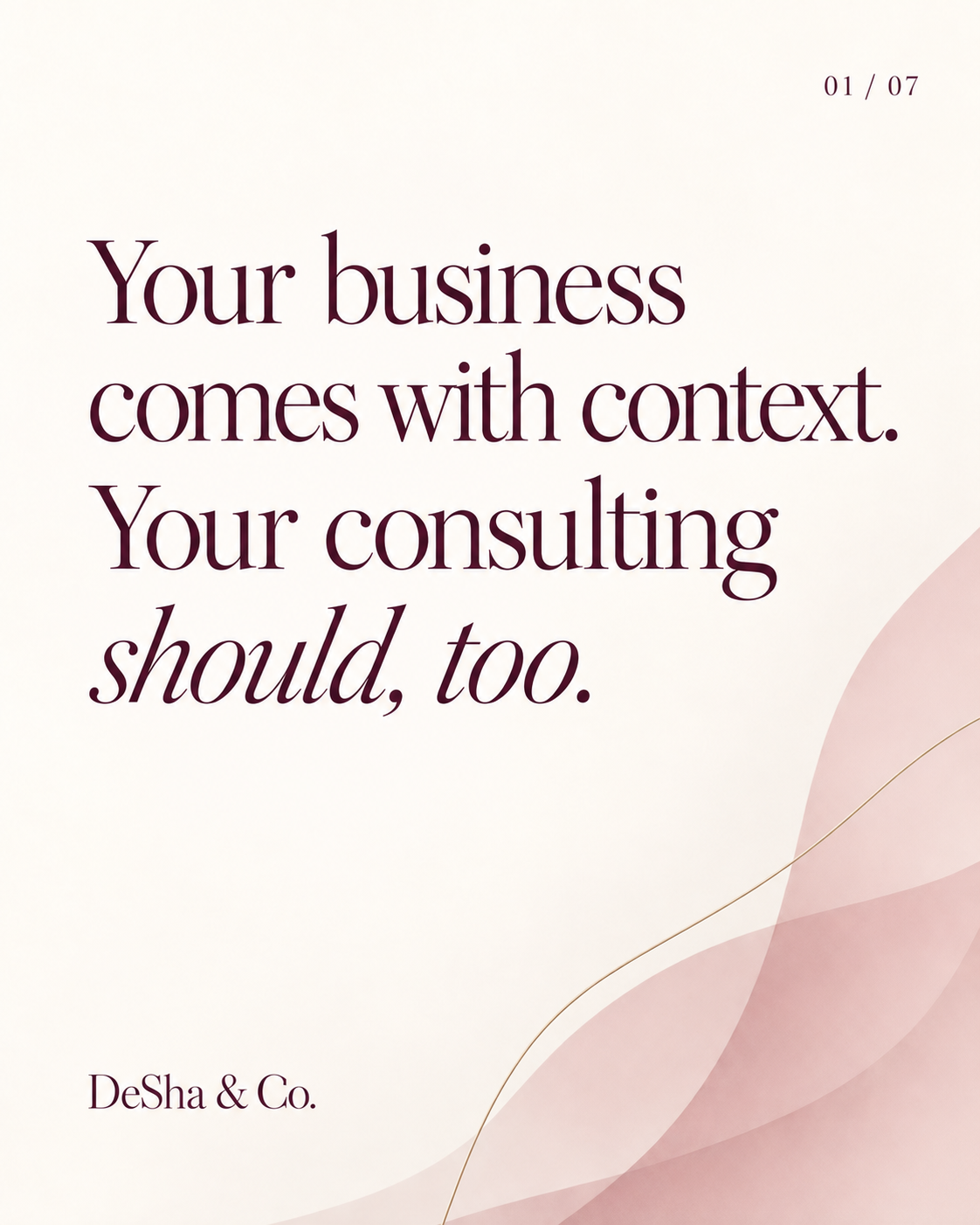
Your business is not a template—and your consulting experience should reflect that. Learn how DeSha & Co. approaches small business consulting through practical systems, individualized attention, and collaborative support designed around you.

Small business owners work hard for every dollar that comes through the door.
When you decide to reinvest some of those hard-earned dollars into small business consulting, I believe you deserve more than a generic presentation, a recycled framework, and a list of recommendations that someone hopes will work after they leave.
You deserve someone who takes the time to understand your business.
Your customers. Your systems. Your team. Your goals. Your capacity. Your challenges. Your personality. And yes, sometimes even the slightly strange workaround you created three years ago that somehow became the backbone of the entire operation.
That is why I built DeSha & Co. as a boutique business operations consulting practice.
I wanted to create the kind of consulting experience I believe small business owners deserve: thoughtful, personal, practical, collaborative, and designed around the business that actually exists.
Not the imaginary perfect business in a textbook.
Your Business Is Not a Template
There are certainly common challenges across small businesses.
Processes become messy as the company grows.
Customer communication starts taking more time.
The founder becomes the person everyone depends on.
Software gets purchased but never fully implemented.
Important information lives in someone’s head.
Decisions pile up.
The business grows faster than the systems supporting it.
Those patterns may be common, but the solution is rarely identical from one business to another.
A workflow that works beautifully for one business may be completely unrealistic for another.
The software stack that makes one founder feel organized may make another want to throw their laptop into a decorative pond.
And a system can be technically efficient while still being completely unusable for the people expected to maintain it.
That is why good business operations consulting has to begin with understanding.
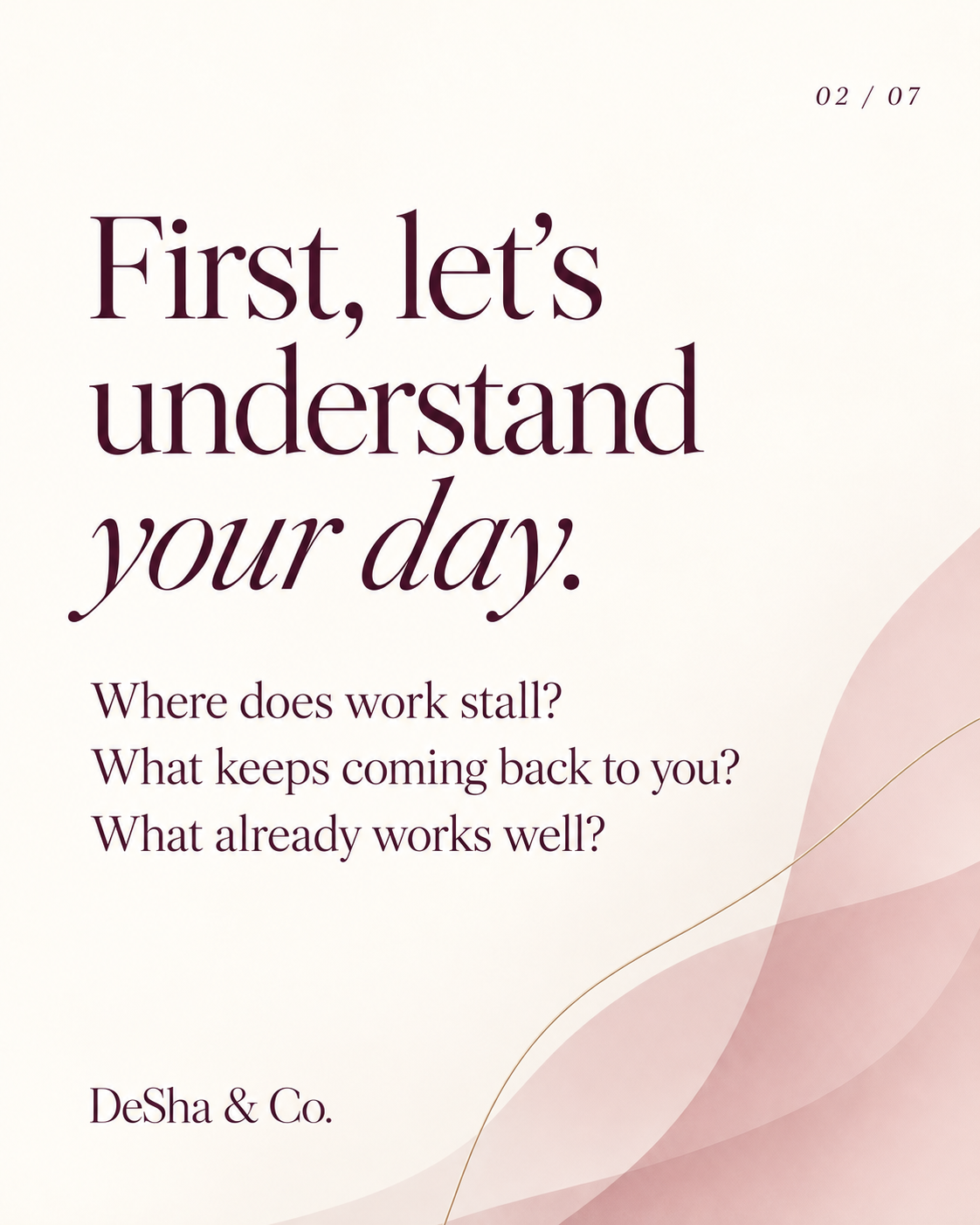
Before I start recommending changes, I want to know:
What is actually happening?
Where is the friction?
What is already working?
What does the owner want to protect?
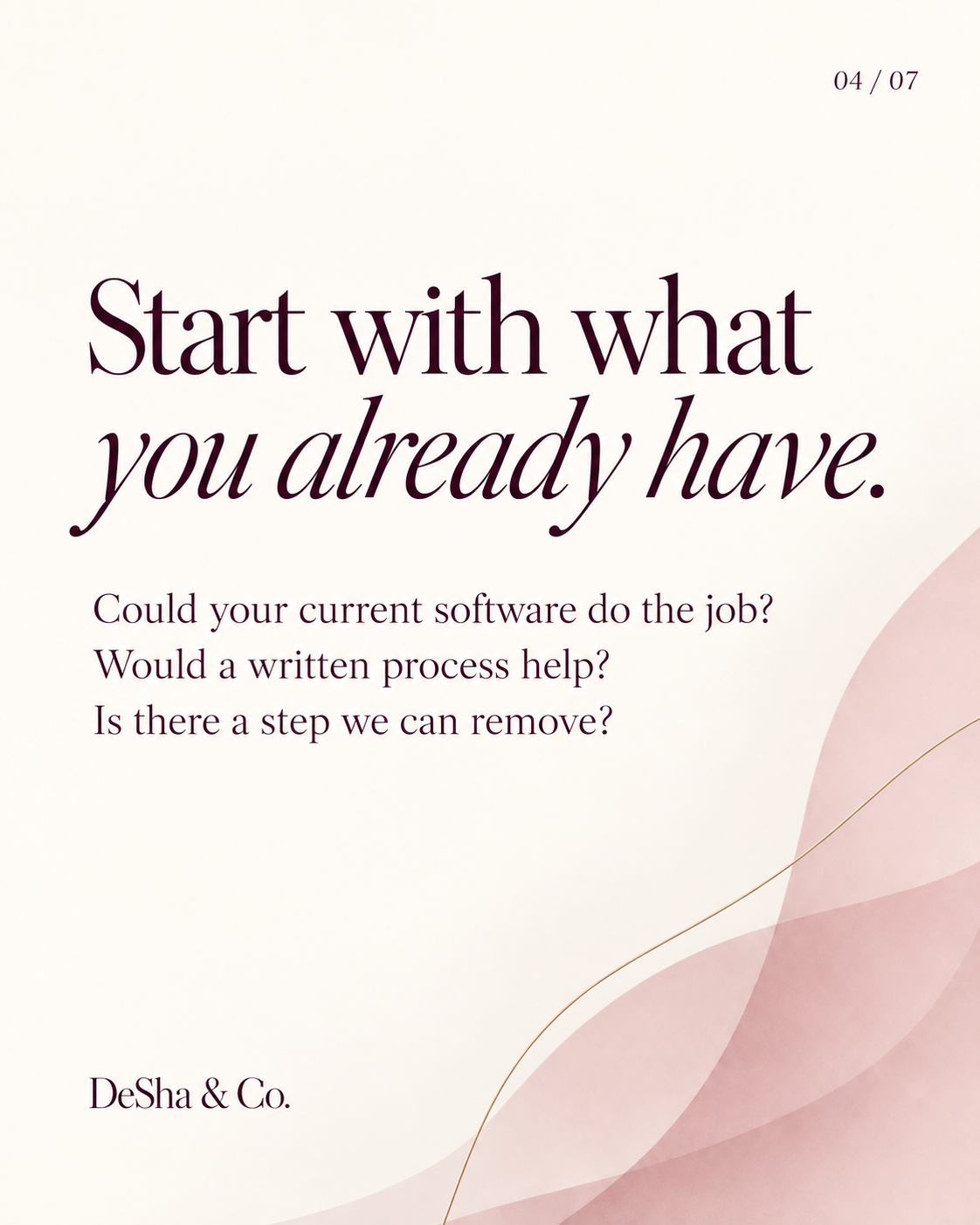
What tools are already available?
What is taking too much time or energy?
What does the business realistically have the capacity to maintain?
Because sometimes the right answer is not another platform.
Sometimes it is simplifying the one you already have.
Sometimes it is documenting a process.
Sometimes it is changing how customers receive information.
Sometimes it is clarifying who owns a decision.
And sometimes the smartest business strategy is simply removing three unnecessary steps everyone has been doing because “that’s how we’ve always done it.”
Boutique Consulting Means You Should Feel Known
The word boutique is important to me.
It does not just mean smaller.
It means intentional.
DeSha & Co. is intentionally designed to provide individualized attention rather than treating every client like the next account moving through a consulting machine.
When I work with a business owner, I want to understand enough about the business to recognize the difference between the obvious problem and the actual problem.
For example:
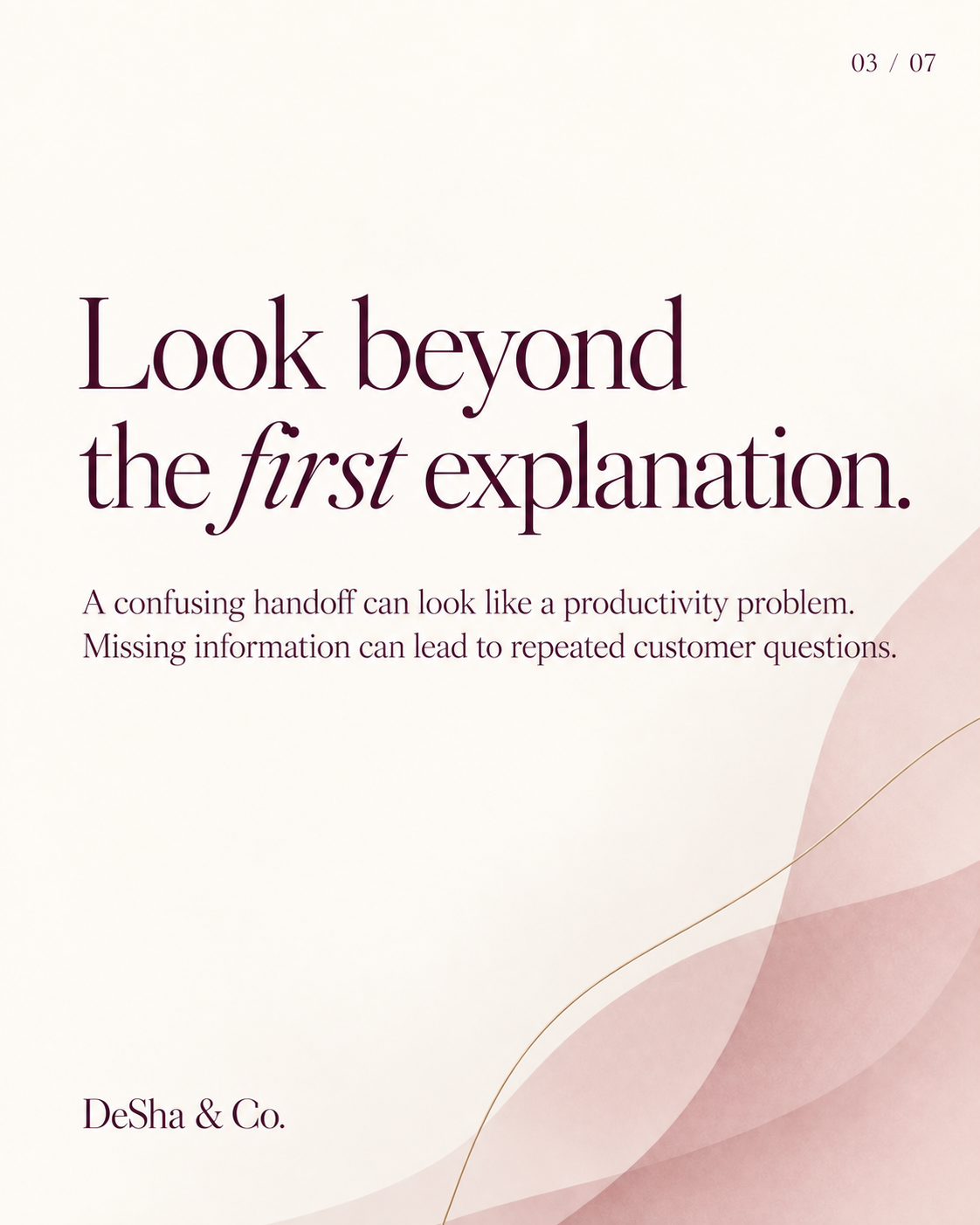
A founder may think they have a productivity problem.
After looking more closely, we may discover they actually have a workflow problem.
A customer-service issue may really be an expectation-setting problem.
A leadership problem may actually be unclear ownership.
A capacity problem may be caused by unnecessary manual work.
A software problem may simply be a knowledge gap.
That is where business process improvement becomes powerful.
We are not just asking:
“How can you do more?”
We are asking:
“How could this work better?”
Those are very different questions.

I Believe in Integrated Partnership
Depending on the service you choose, my role may go beyond sitting across from you and offering advice.
I believe in what I call an integrated partnership.
That means I get close enough to the business to understand the moving parts.
I become part of your thinking process.
I ask questions.
I look at the systems.
I help untangle the process.
I pressure-test decisions.
I identify gaps.
I help create resources when appropriate.
And because I have spent nearly 20 years working across business and technology operations, I also bring experience with a wide variety of software, systems, platforms, workflows, and operational tools.
Sometimes that means helping you build something.
Sometimes it means showing you how to use what you already have more effectively.
Often, it is both.
I love the combination of producing and knowledge-sharing.
I do not want to hand you something impressive-looking that you cannot maintain once I leave.
I want you to understand what we created, why it works, and how to use it.
That is part of building sustainable small business operations.
Consulting Should Not Create Dependency
There is a version of consulting where the consultant becomes indispensable because nobody else understands what they built.
That is not the goal here.
My goal is to help make you and your business more capable.
That may mean creating:
documented processes
clearer workflows
customer communication templates
operating procedures
intake and onboarding systems
business dashboards
decision-making frameworks
stronger operating rhythms
better use of existing software
clearer roles and responsibilities
more sustainable ways of working
The point is not to bury your business under more infrastructure.
It is to build the right infrastructure for the business you are actually running.
There Is No Judgment About Where Your Business Is Today
This is one of the most important parts of how I work.
You do not need to organize your business before asking for help organizing your business.
You do not have to apologize because the process lives in your head.
You do not need to be embarrassed because you bought software six months ago and still do not know what half the buttons do.
You do not need to pretend you understand something you do not understand.
And you definitely do not need to create a polished version of the problem before bringing it to me.
We start where you are.
I am solution-focused.
The question is not:
“How did you let the business get here?”
It is:
“What would make this work better from here?”
That distinction matters.
Especially for small business owners who already carry enough responsibility without hiring someone to make them feel inadequate about it.
Different Business Owners Need Different Systems
I am neurodivergent, and that has deeply influenced how I think about business operations.
I notice patterns, friction, inconsistencies, systems, communication, and the people interacting with all of those things.
One of the principles behind my work is simple:
The business should support the brain running it.
There is no single correct way to organize, communicate, plan, lead, or make decisions.
Traditional productivity advice sometimes assumes every business owner should work the same way.
I do not.
Good systems should account for the humans using them.
That might mean clearer written processes.
More visual organization.
Fewer platforms.
More automation.
Better reminders.
Different communication norms.
More processing time before decisions.
A simpler operating cadence.
Or reducing unnecessary decision-making altogether.
A strong business operations strategy should make the business easier to operate, not give the founder another complicated system to maintain.
What Are You Actually Investing In?
When you hire a small business consultant, you are not simply purchasing an hour on someone’s calendar.
You are investing in perspective.
Experience.
Pattern recognition.
Problem-solving.
Decision support.
Operational knowledge.
And, in my practice, partnership.
You are hiring someone to step outside of the day-to-day noise and help you see what can be difficult to see when you are standing in the middle of it.
That is why I believe small business owners deserve an experience that feels thoughtful and personal.
You worked hard to build the business.
Your consulting experience should respect that.

Sometimes You Need a Project. Sometimes You Need a Partner.
DeSha & Co. offers different levels of support because not every business challenge needs the same type of engagement.
Sometimes something specific needs to be fixed or redesigned.
That is where a CEO Consulting Engagement may make sense. It is a defined, project-oriented engagement focused on operational improvement, process redesign, systems, workflows, customer experience, capacity, or another clearly identified area of the business. DeSha & Co.
Other times, there is not one project to complete.
The business is simply evolving, and the founder needs an experienced strategic partner in the room as new decisions, customer issues, leadership challenges, priorities, and growth opportunities arise.
That is the purpose of CEO Collaboration and CEO Collaboration Plus. Collaboration Plus, in particular, is designed as a higher-touch ongoing strategic partnership rather than a single defined operational project.
The goal is to choose the level of support that matches what the business actually needs, rather than squeezing every challenge into the same consulting package. DeSha & Co.’s current service structure ranges from focused one-time support through defined consulting engagements and ongoing collaboration.
Your Hard-Earned Investment Should Feel Like an Investment
If you are spending your hard-earned money on consulting, you should leave with more than notes.
You should have greater clarity.
Better decisions.
Practical next steps.
Systems that make sense.
A stronger understanding of your business.
And ideally, a little more breathing room.
That is the experience I want to create at DeSha & Co.
There will probably be a few laughs along the way.
There will definitely be questions.
There may be spreadsheets.
There will almost certainly be a moment where I ask, “But why are we doing it that way?”
And sometimes the answer will be completely legitimate.
Sometimes we are going to stare at each other for a second and realize nobody actually knows.
Either way, there is no judgment.
We figure it out.
Together.
Because I do not believe consulting should feel like someone standing outside your business tossing solutions over the fence.
I want to get in it with you.
That is what partnership means to me.
And that is the kind of boutique consulting experience I believe small business owners deserve.
Ready for a Different Kind of Small Business Consulting?
If your business is growing, changing, or simply feeling heavier than it should, you do not have to figure out every operational decision alone.
DeSha & Co. provides boutique business operations consulting, founder advisory, and neuro-affirming business coaching designed around your actual business and the person leading it.
Build simply. Lead sustainably.
→ Explore Ways to Work Together
→ Tell Me What’s Feeling Heavy
|Small Business Consulting • Business Operations • Founder Advisory • Small Business Strategy • Business Process Improvement • Entrepreneurship • Leadership • Sustainable Growth • Neuro-Affirming Business|
Founding DESHA & CO. Story
I come from a family of women who know what it means to build something of their own.
My mother is a successful business owner, and my grandmother was too. I grew up seeing firsthand the courage, persistence, problem-solving, and heart it takes to create and sustain a business. That has always shaped the way I see entrepreneurship. Small businesses are deeply personal. They are often built from someone’s gifts, convictions, livelihood, family, and vision for what could be.
Now, at this stage of my life, many of my own friends are building businesses that are beginning to thrive. As I have watched them grow, I have also seen the familiar challenges that come with that growth: more decisions, more customers, more moving pieces, and systems that sometimes struggle to keep up with the success they were built to support.
And I realized something very clearly: this is where my experience can help.
I have spent nearly 20 years in the corporate America workforce, building experience across business and technology operations, program management, process improvement, stakeholder leadership, organizational change, and service delivery. Along the way, I have worked with a wide range of software, platforms, systems, workflows, and business tools.
That experience matters because I do not just bring strategy into the room. I also bring practical knowledge of how tools and systems can support the business behind the scenes. When appropriate, I can help clients evaluate what they are already using, identify ways to get more value from it, introduce better ways of working, and knowledge-share so they feel more confident using the systems that support their business.
I love being able to both help produce and help teach. My goal is not to create dependency. It is to help clients gain more clarity, capability, and confidence as we work together.
I am also neurodivergent, and that is an important part of how I work.
I bring my whole brain to the table. I notice details, patterns, friction, people, emotion, and process, often all at once. I care deeply about creating a working environment where people feel safe enough to be honest about what is working, what is not, and what they simply have not figured out yet.
There is no judgment here.
You never have to clean up your business before you bring it to me. You do not need to have the perfect systems, the perfect answers, or even the perfect explanation for why something feels hard. We start where you are and focus on what we can do next.
We are solution-focused here.
And while there will absolutely be some laughs along the way, I take the trust my clients place in me seriously. When you work with me, you get my presence, my professional experience, my emotional intelligence, my curiosity, and a very big heart for helping people succeed.
My faith is part of that heart, too.
I have a big faith, and it shapes the way I lead, serve, and show up for people. If you are comfortable bringing faith into our work, we can pray together. If you are not, there is no pressure whatsoever.
Just know this: I am probably praying for you anyway.
I am praying for wisdom, clarity, peace, good decisions, healthy growth, and for all of us to win.
That is what DeSha & Co. is about for me. Building better businesses, yes. But also helping the people behind those businesses feel supported, capable, and a little less alone while they build them.
Let’s work together